

Meta Ads agency for D2C brands in India
Scaling Socials runs full-funnel Meta advertising, across Facebook and Instagram, for D2C and ecommerce brands in India and the UAE. That means prospecting, retargeting, and Advantage+ where it beats manual, all fed by an in-house creative pipeline and managed to your real margin rather than a platform-flattered ROAS.
Five years in, we have run Meta ads for 400+ brands, always inside their own ad accounts. The account stays yours. So does the pixel. And so does the data we build in it.
How we structure a Meta account
There is no template. The structure follows the budget and the stage the brand is at, and both of those change.
Number of campaigns follows the budget. A brand spending ₹10,000 a day cannot support the same account architecture as a brand spending ₹1 lakh a day, and pretending otherwise is how testing budgets get spread so thin that nothing reaches significance. We have run both ends of that range and completed a clean testing phase in both, but the campaign count, the ad count and the daily allocation get worked out from your monthly marketing budget downward, not from a slide deck.
Prospecting versus retargeting follows the audience you already have. If you come to us with an existing customer base, a real Instagram following and warm audiences already sitting in your account, we start retargeting from week one because the money is already there to be collected. If you are starting cold with no pixel data and no audience, almost everything goes to prospecting first, because until we know which cold audiences add to cart and initiate checkout, there is nothing to retarget.
- Cold
- Warm
- Retarget
- Convert
The funnel runs in that order every time.
CBO or ABO is a testing decision, not a preference
Some accounts stay CBO-led, some ABO-led. It depends on the account, and on where that account is in its testing cycle.
How we choose between campaign budget optimisation and ad-set budgets.
High-budget CBO
- We reach for it when
- The budget can move through testing quickly
- What it is doing
- Multiple ad sets and creatives, one variable changed at a time — creative, or interest, or age, or gender, never all at once
- What it buys us
- Speed to a verdict
ABO
- We reach for it when
- A winner is already clear
- What it is doing
- Holding a proven creative or audience on a budget we control directly
- What it buys us
- Control, so the winner can be scaled
| High-budget CBO | ABO | |
|---|---|---|
| We reach for it when | The budget can move through testing quickly | A winner is already clear |
| What it is doing | Multiple ad sets and creatives, one variable changed at a time — creative, or interest, or age, or gender, never all at once | Holding a proven creative or audience on a budget we control directly |
| What it buys us | Speed to a verdict | Control, so the winner can be scaled |
Starting point: 1.75x ROAS under a previous agency, spend spread across positions that never earned it.
Where it got to: 3.94x in a single quarter, revenue up 204% on 35% more spend — our worst month still beat their previous best.
Read the women’s fashion turnaroundCreative is the lever, not the settings
Since the Andromeda update, the volume and quality of creative running through an account matters far more than how neatly the account is organised. We produce statics and video-led ads in-house and push them through a structured testing pipeline, so winners get found by spend rather than by the loudest opinion in the room.
We do not commit to a fixed number of creatives per month, because that number is an output, not a target.
How a test is judged
Every campaign is reviewed on a three to four day cycle against the objective it was launched for. A campaign producing strong CTR and healthy add-to-carts gets more time even if the sales have not landed yet, because the signal is there. Anything not trending toward a winner gets switched off quickly.
Sales are not the fair measure in every phase, so the measure changes with the objective.
Judged on
- Sales
- ROAS and order volume
- Lead generation
- Cost per lead and lead quality
- Brand building
- CTR, CPC and CPM
What counts as a winner
- Sales
- Profitable ROAS and consistent orders
- Lead generation
- Leads your sales team can actually close
- Brand building
- Metrics trending toward a winner
Killed when
- Sales
- No sales inside the three-to-four-day window
- Lead generation
- Leads are cheap but unclosable
- Brand building
- No trend toward a winner
| Campaign is for | Judged on | What counts as a winner | Killed when |
|---|---|---|---|
| Sales | ROAS and order volume | Profitable ROAS and consistent orders | No sales inside the three-to-four-day window |
| Lead generation | Cost per lead and lead quality | Leads your sales team can actually close | Leads are cheap but unclosable |
| Brand building | CTR, CPC and CPM | Metrics trending toward a winner | No trend toward a winner |
A killed campaign is replaced, not just switched off — new interest, new age band, new creative, new angle. Cheap leads your sales team cannot close are not a result.
Advantage+ where it earns its place
Advantage+ Shopping is a genuinely good update and we have seen it produce strong results, but it earns its place in two specific situations rather than by default.
Where a manual structure gives us control worth paying for, we stay manual — the same call we weigh on Advantage+ versus a manual campaign structure, and the one Google forces too with Performance Max. Either way, the campaign is held to your break-even ROAS, calculated from your margin with our break-even ROAS calculator, not to a rule of thumb.
Starting point: capped at 3–5x for a year — a stable account that had quietly stopped growing.
Where it got to: 7.09x across seven months while spending more than ever, worst month still 5.83x.
Read the womenswear scaling storyHow we approach targeting
We have not dropped anything. Broad, manual interests and lookalikes all still get tested — in that order of priority.
- 1
Broad
Meta’s models in 2026 are considerably better at finding buyers than a hand-built interest stack.
- 2
Manual interests
The foundation of advertising, and it still works — particularly where a brand has a sharply defined customer.
- 3
Lookalikes
In proportion to the purchase data available. With enough purchasers in the account, these become one of the most reliable parts of the structure.
What works is decided per brand, by testing, not by a house rule.
What the first 90 days look like
-
Onboarding
A health check before a single campaign goes live: your whole path from homepage to purchase confirmation, your pixel, and an audit of everything the account has run before.
-
Month one content
Campaigns go live and the month is spent finding which content angles work: statics, video, catalogue. A call every week on what happened and what is next.
-
Month two targeting
With the content question answered, the month goes on audiences: which interests, which age bands, which locations, which structures.
-
Month three consistency
All three answers in hand — the content, the targeting and the structure that work. This is where consistent sales and stable revenue become a fair expectation.
Inside onboarding
Before a single campaign goes live, we walk your entire path from homepage to purchase confirmation, looking for the breaks — add to cart, checkout initiation, billing details, payment. A slow or broken store is the most common thing quietly capping paid results, so this is also where we flag website and store-speed problems that campaign changes can never fix. We then verify your pixel is firing correctly and connected properly to the ad account, and audit everything run on the account historically — money already spent is data already bought.
That audit becomes your month-one plan. Whatever showed positive signal in the past gets priority; whatever failed gets avoided outright. Alongside it you get a creative brief, so you know exactly what images and videos we need from you and by when. When we produce the creative, our design team and our media buyers plan the campaigns and the creative together, in the same room. Most agencies get this wrong — designers make whatever they make and the buyer runs it. We do not work that way.
Strong, consistent ROAS. During testing, losing campaigns will outnumber winners — that is what testing is. Brands that hold their nerve through that window are the ones that see month-on-month growth afterwards. Patience in the testing phase is not optional.
Starting point: the first two months returned ₹0 — no proven product, no data, a genuinely hard call to keep going.
Where it got to: ₹1.19 crore in year one at 6.23x average, with monthly budget grown 44x against proven performance.
Read how the wellness brand scaled from zeroBrands we do not work with
- Brands expecting 5X or 7X in month one. That is not how testing works and we will not pretend otherwise to win an account.
- Ad-spend budgets of ₹10,000–₹20,000 a month. There is no version of that budget that produces a meaningful result, and taking it would waste your money and our time.
- Brands that want a vendor rather than a partner — not open to changing pricing, improving the product, fixing the website or investing in content.
- Illegal products, and anything overpriced and sold on hype without delivering value.
We will always tell you what is actually holding sales back, and that only works if you want to hear it. We work with brands that have a realistic view of where they want to be in a year and are willing to build toward it. If you are not sure that is you, our note on who we turn down and why is an honest read.
Five years, inside your own account
- 400+ D2C and ecommerce brands
- 150+ brands scaled past ₹10 lakh in monthly revenue
- 50+ brands taken past ₹1 crore in cumulative sales
- ₹10 Cr+ Ad spend managed
Official Meta Business Partner
-
Social Analytix, our in-house AI tool
Monitors every live campaign in your ad account in real time and flags what to pause, what to scale, and where budget is leaking — so decisions happen on the day, not at the end of the month.
-
Experienced media buyers only
We keep the team small and qualified rather than filling it with volume hires and assigning your account to whoever is free.
Straight from Ads Manager
Scaling Socials runs Meta ads for D2C brands in India and the UAE, inside each client's own ad account. Below are twelve of those accounts, screenshotted in Meta Ads Manager, showing the purchase ROAS and purchase value Meta reports for each.
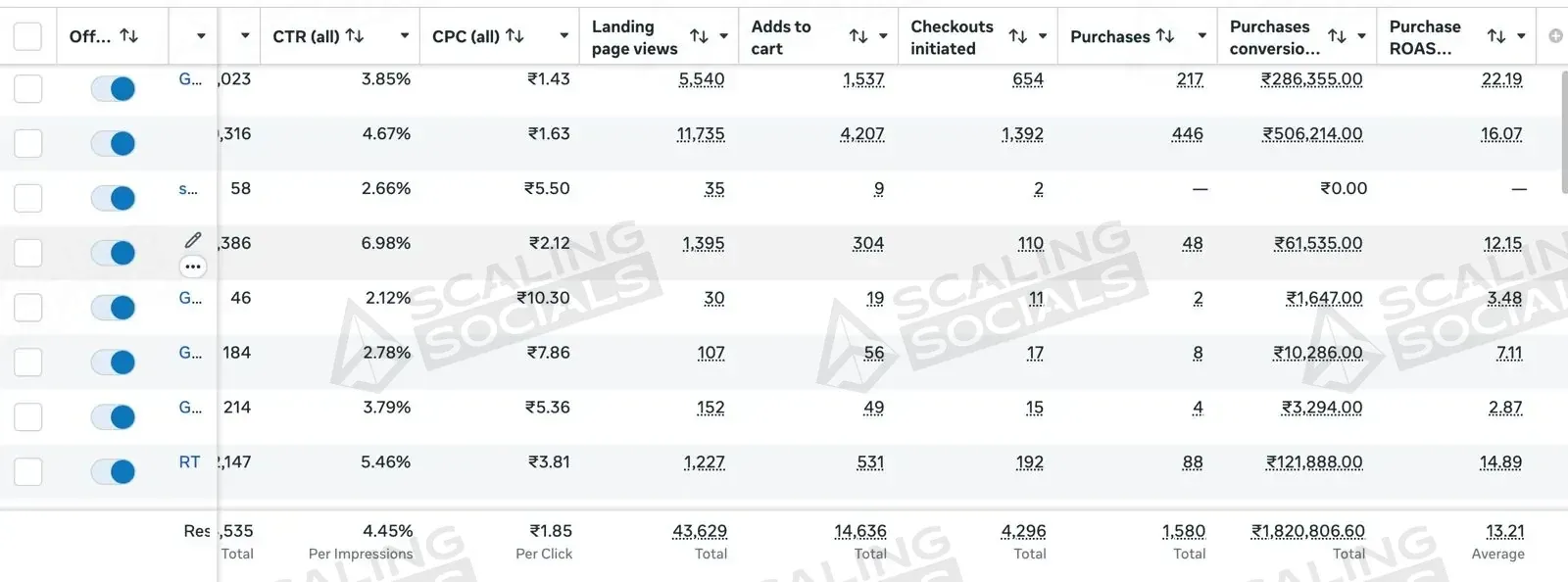
13.21x₹18.21 L purchase value Account 01, full size 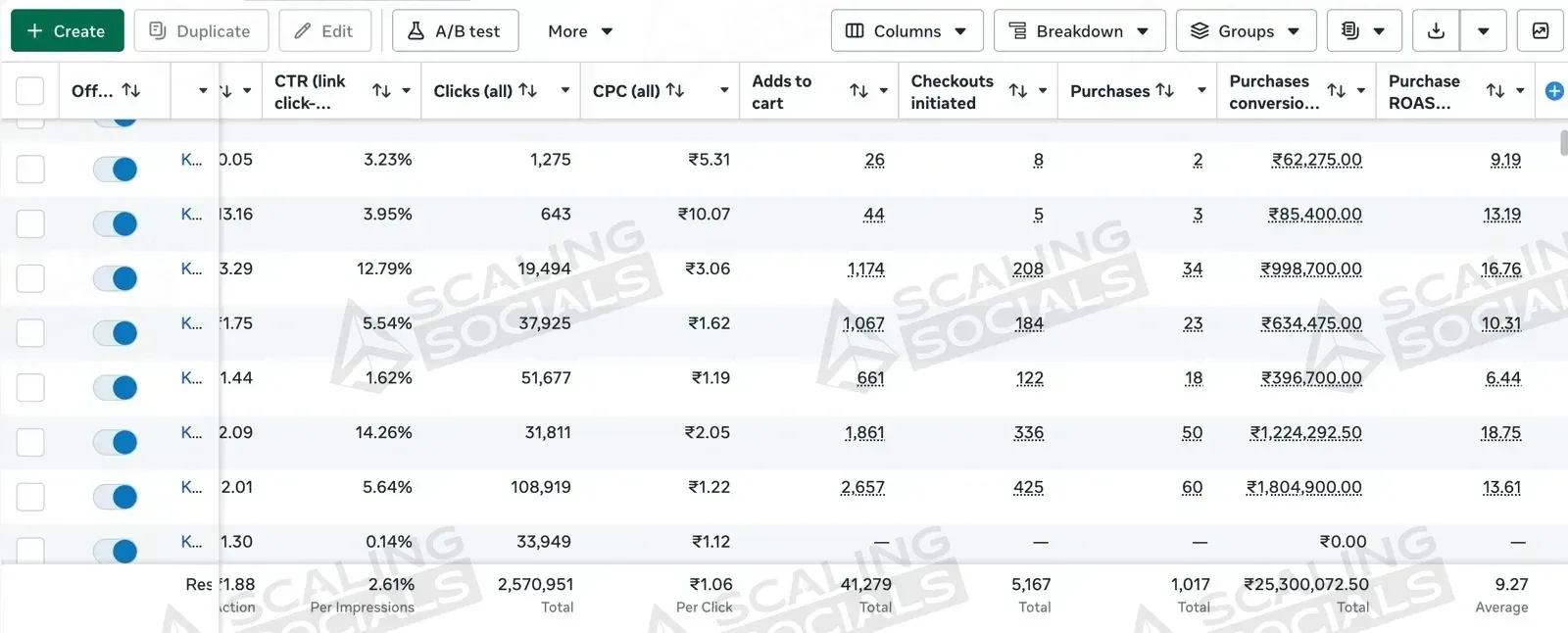
9.27x₹2.53 Cr purchase value Account 02, full size 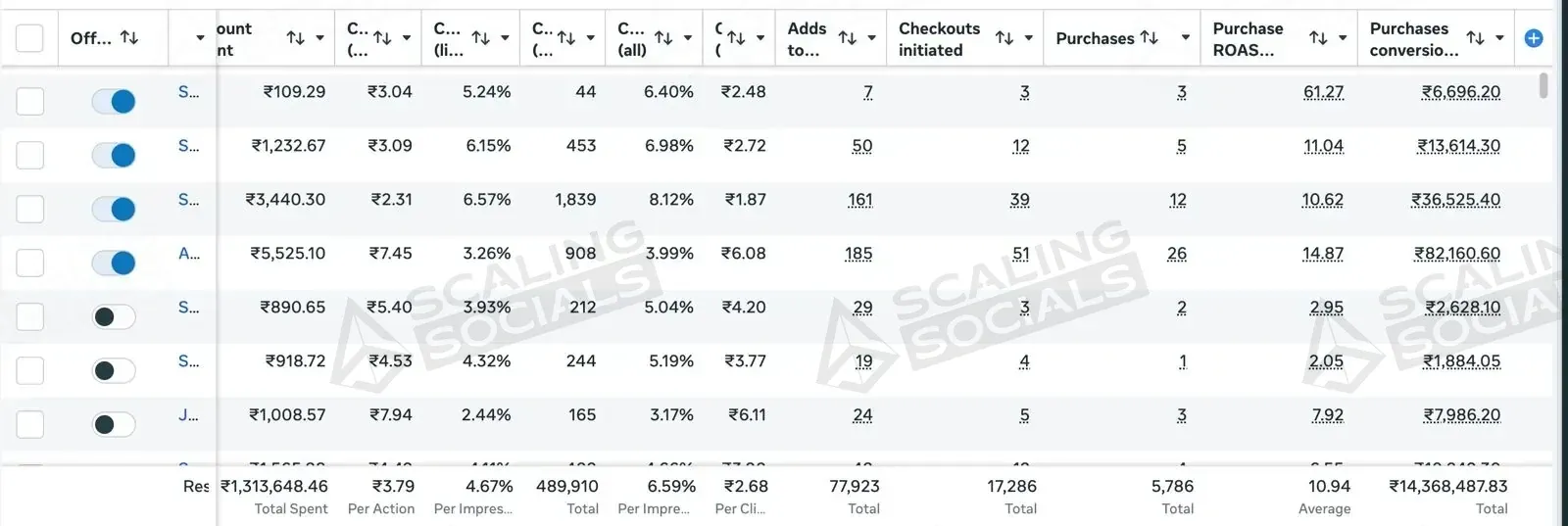
10.94x₹1.44 Cr purchase value Account 03, full size 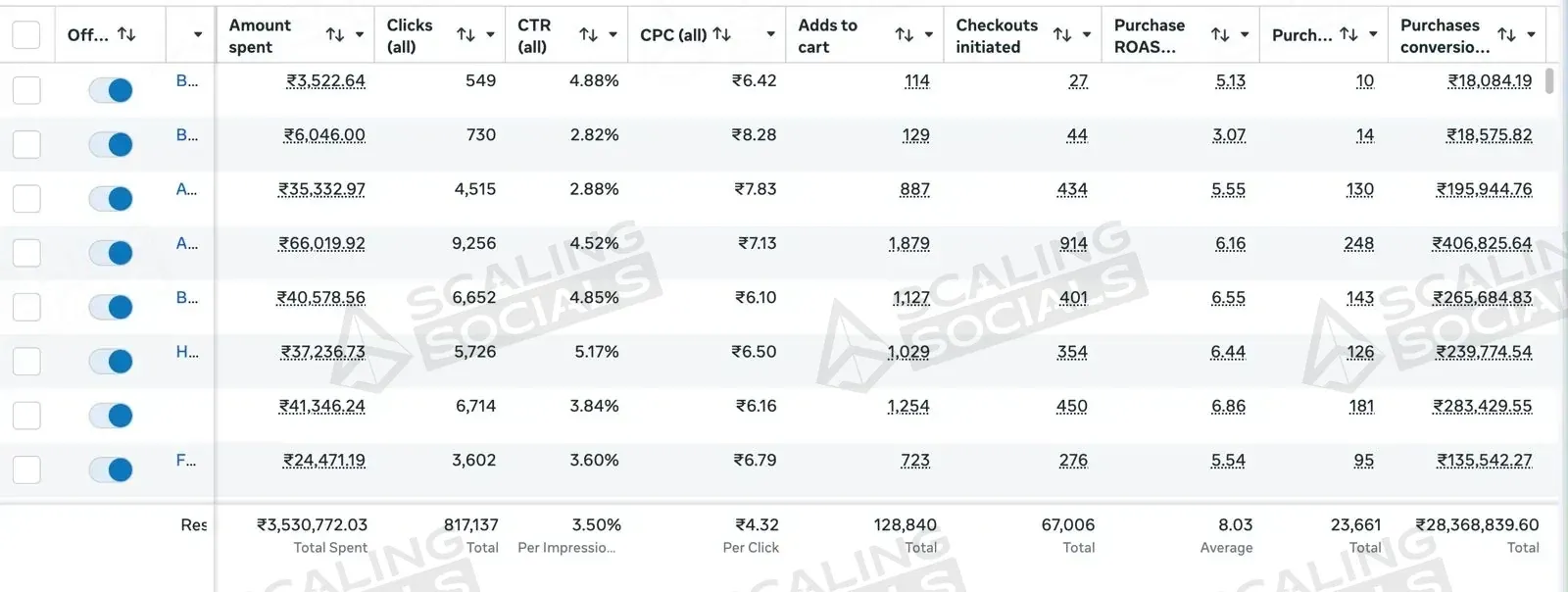
8.03x₹2.84 Cr purchase value Account 04, full size 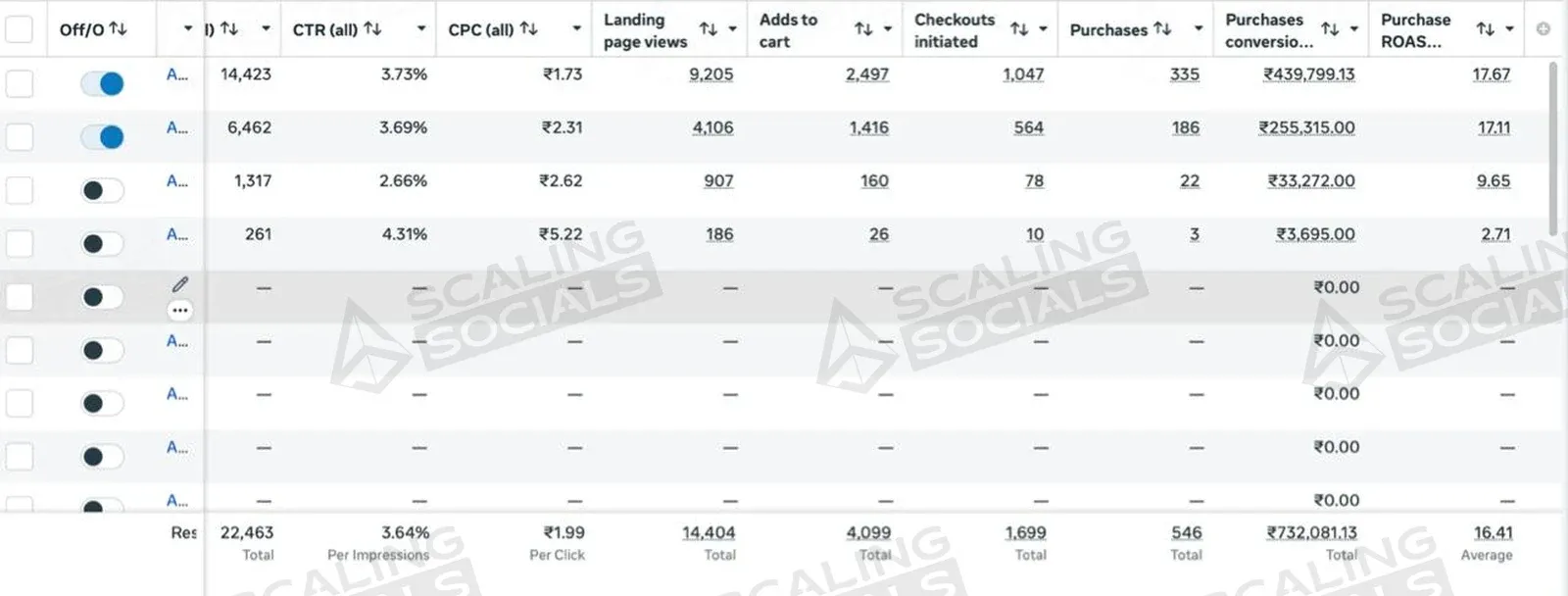
16.41x₹7.32 L purchase value Account 05, full size 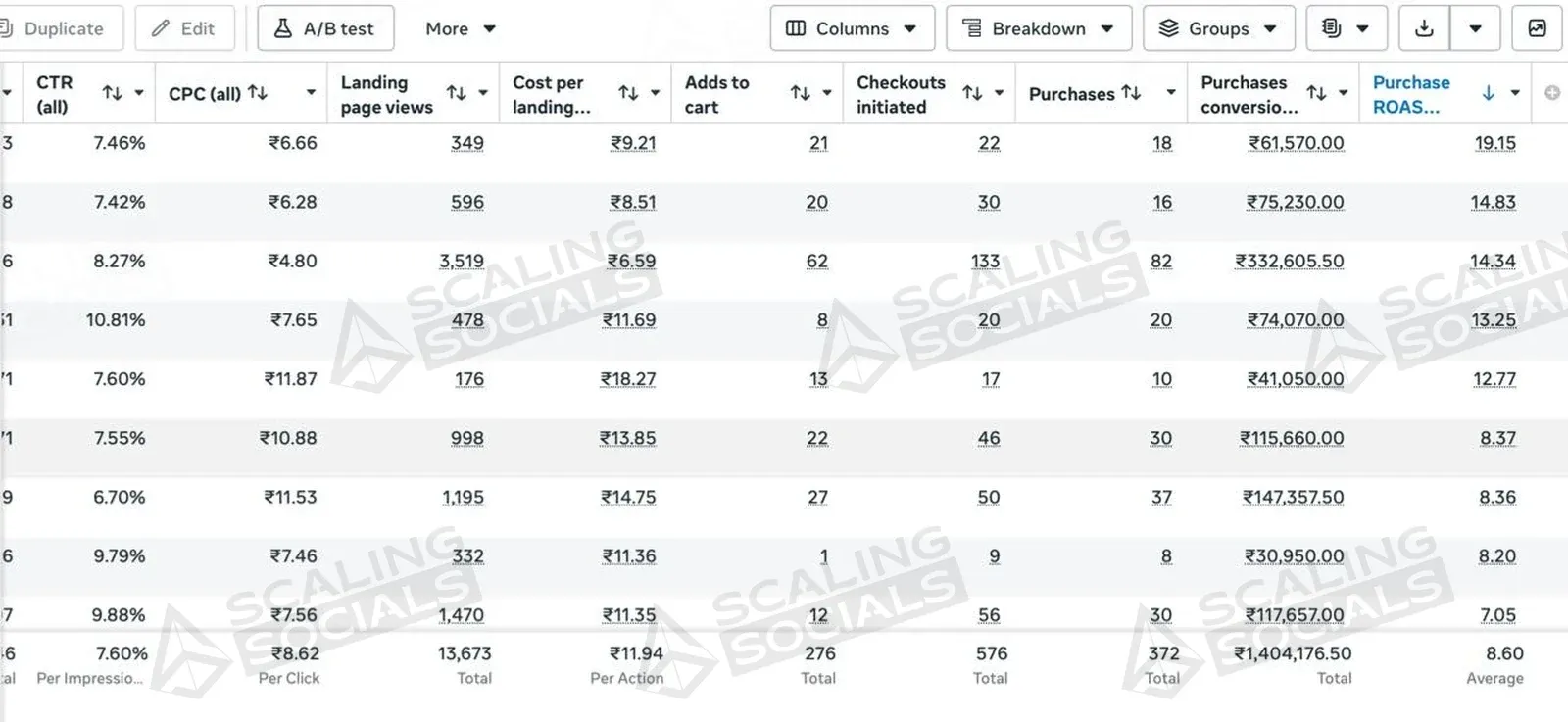
8.60x₹14.04 L purchase value Account 06, full size 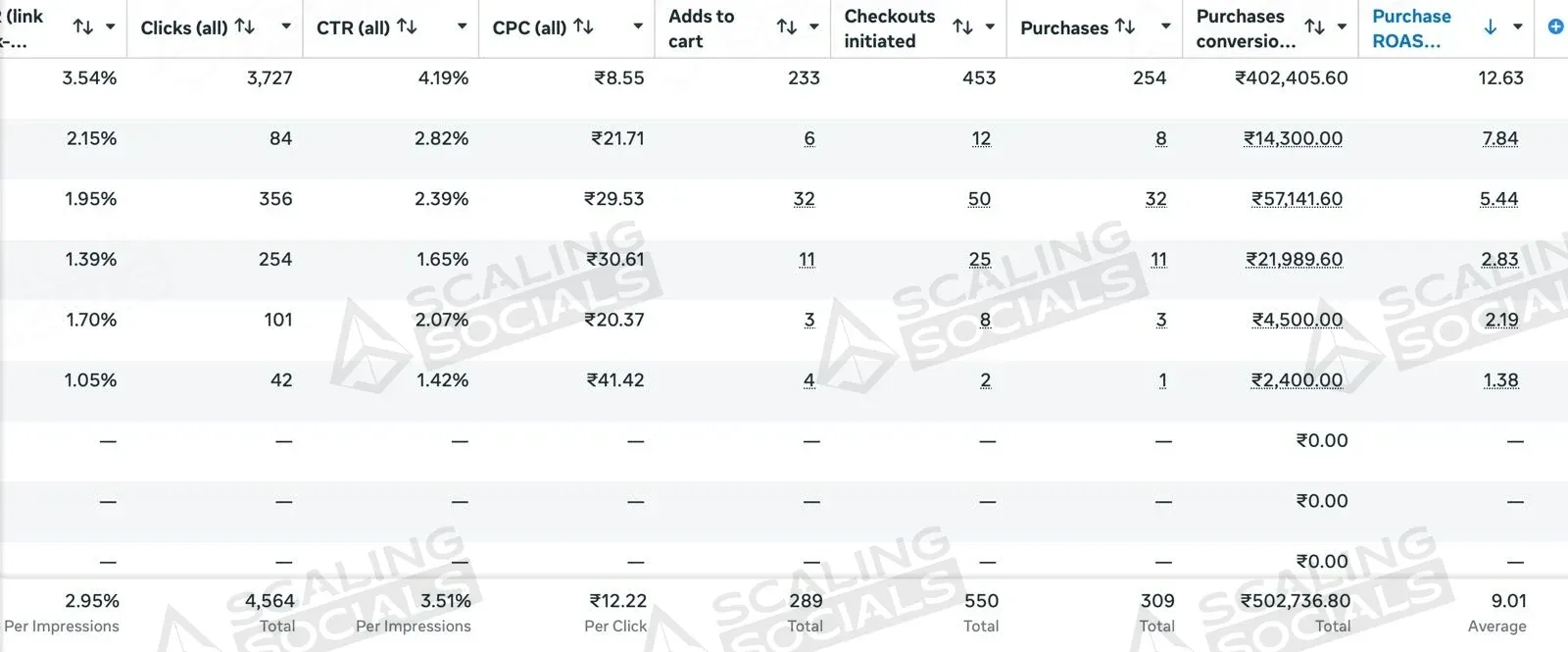
9.01x₹5.03 L purchase value Account 07, full size 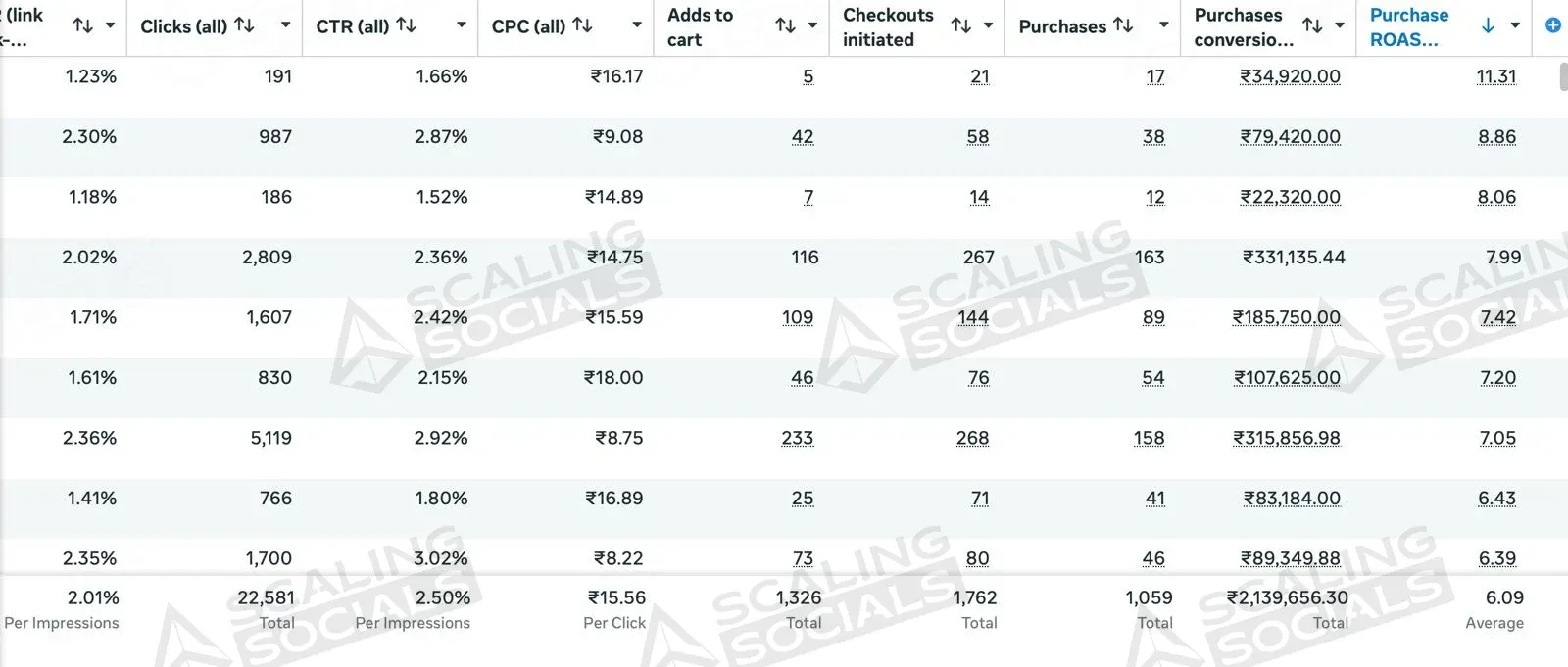
6.09x₹21.40 L purchase value Account 08, full size 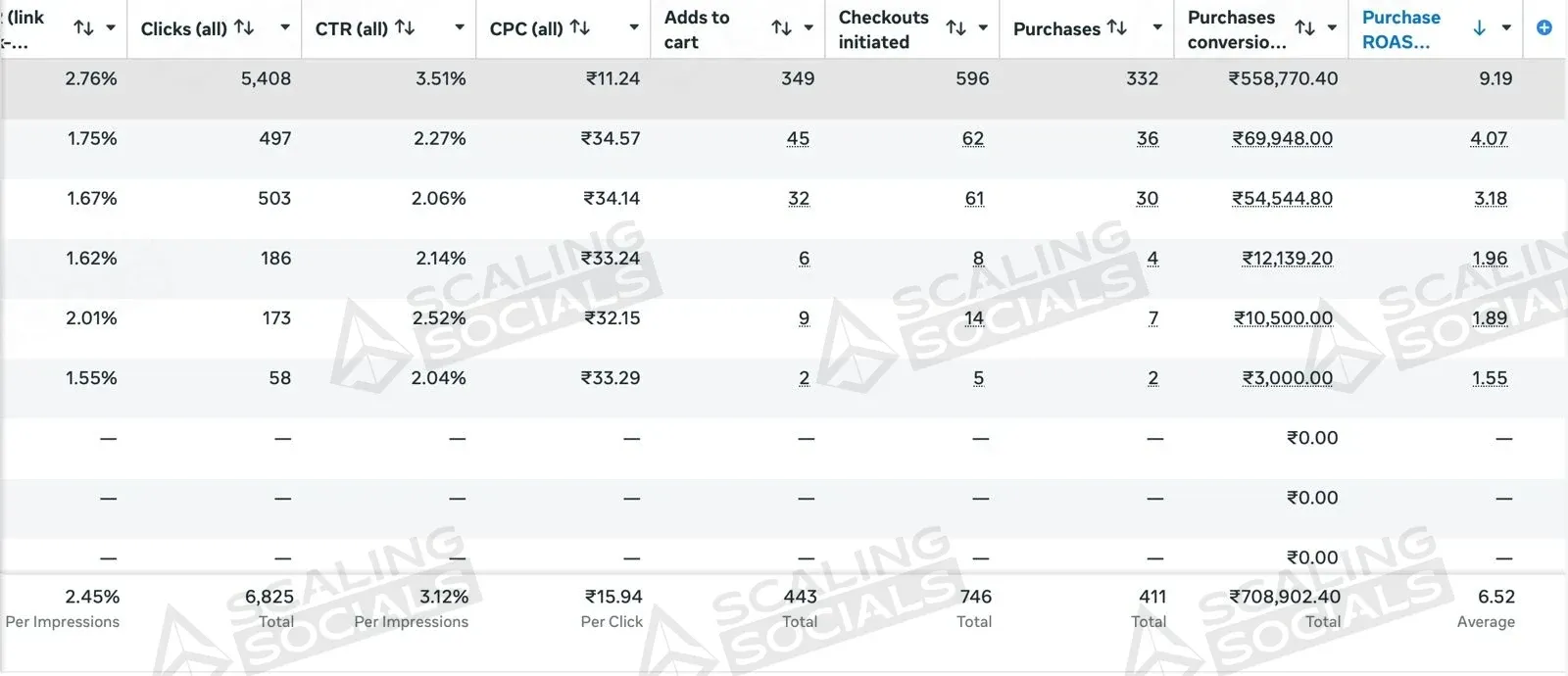
6.52x₹7.09 L purchase value Account 09, full size 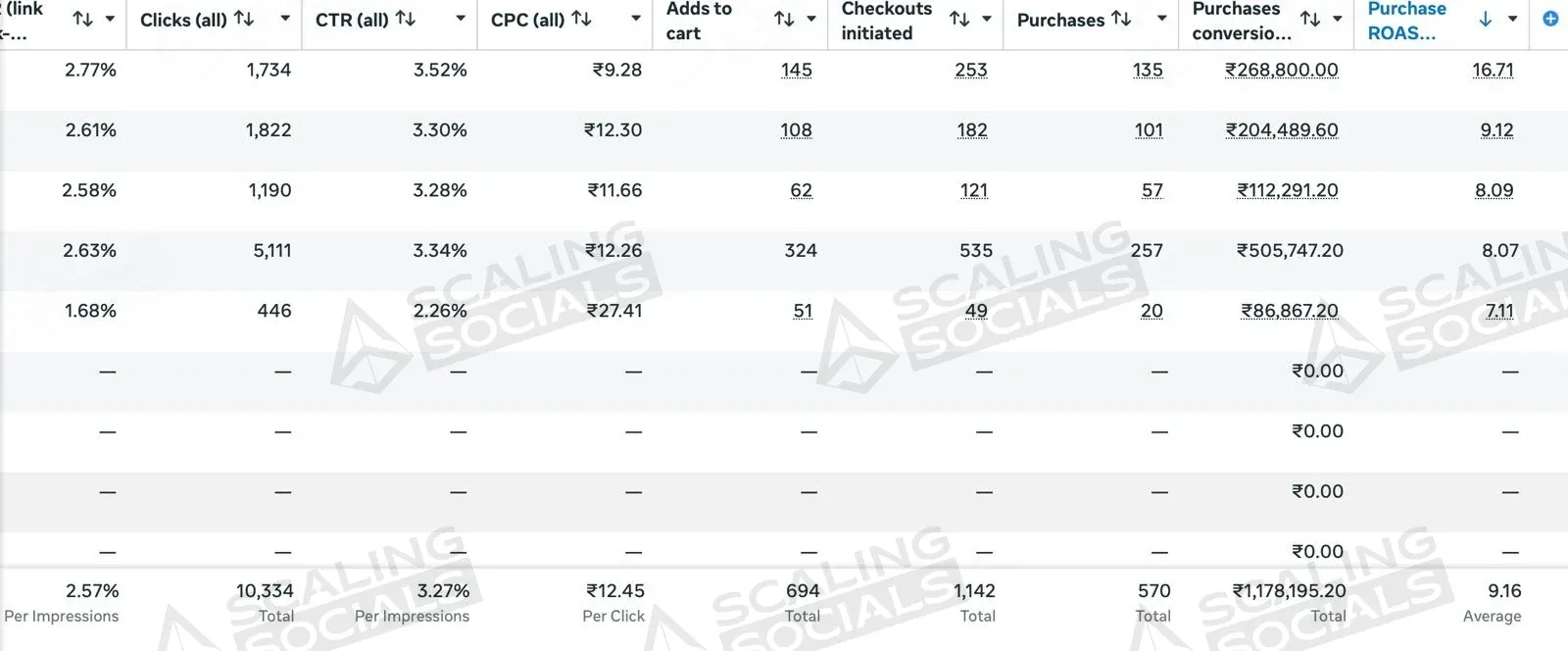
9.16x₹11.78 L purchase value Account 10, full size 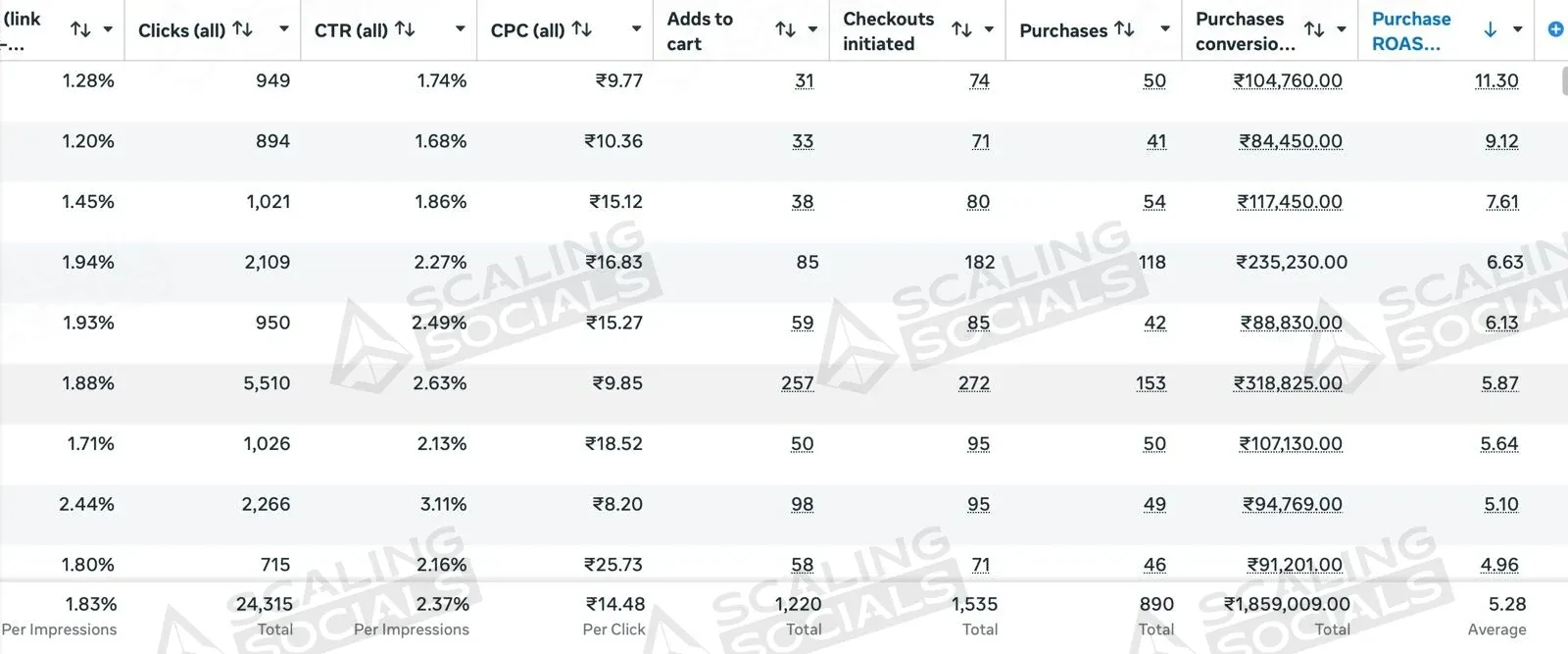
5.28x₹18.59 L purchase value Account 11, full size 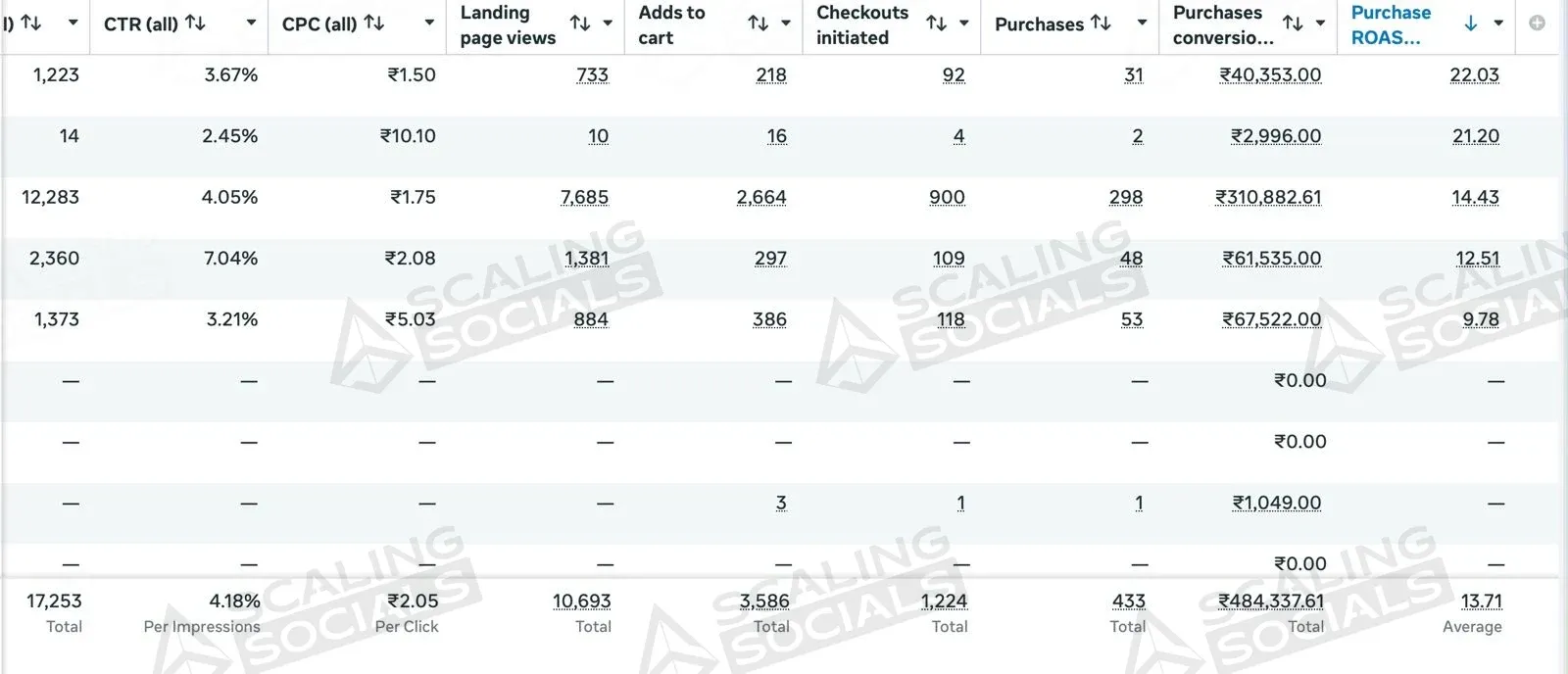
13.71x₹4.84 L purchase value Account 12, full size
Account and campaign names are hidden, and the reporting window differs by account, so each figure is that account's own total rather than a blended agency average. The case studies break seven of them down month by month, worst month included.
Questions founders ask
If yours is not here, ask it directly — you get a written answer whether or not you go on to hire us.
How long before I see results?
Positive traction usually shows in the first month. Consistent sales, stable ROAS and dependable revenue take at least three months, because that is how long a proper testing cycle takes.
Do I pay my ad spend to you?
No. Your ad budget goes directly into your own ad account and straight to Meta. We never mark it up and never route it through us. Everything stays visible to you.
Whose ad account do you run on?
Yours. Every rupee spent is visible in an account you own, which is the only arrangement that is genuinely transparent.
Whose pixel gets used?
Yours. The data we build belongs to you, and it stays with you whether you work with us next year or not.
What is the minimum contract period?
There is not one. We do not lock clients into contracts — you can stop whenever you choose. We suggest giving it three months so you are judging us on results rather than on the testing phase, but that is a recommendation, not a term.
Who will actually run my account — seniors or freshers?
Experienced buyers. We hire for capability rather than headcount, which is why the team is deliberately small.
Do you make the Meta ad creative?
Yes. Statics and video-led ads are produced in-house and tested in a structured pipeline. Creative is the single biggest lever on Meta right now, so it sits at the centre of the engagement rather than off to the side as an add-on.
Should I use Advantage+ or manual campaigns?
It depends on your catalogue and your funnel. We run Advantage+ where it beats manual and stay manual where the control pays off, and we test both against your break-even ROAS.
My Meta ads get traffic but no sales. Is it the ads?
Often it is not. The most common mistake we see in Indian D2C is blaming Meta when the real problem sits after the click. When traffic is healthy and purchases are not, the cause is usually the product, the price, the website or the content — and no amount of campaign restructuring fixes any of those. We check the whole path from ad to checkout before rebuilding an account, and where the leak is on-site we fix it with conversion rate optimisation, not more ad spend.
How does pricing work?
Every engagement is scoped to the brand rather than sold as a fixed package, and it reflects your ad spend and creative volume. Your Meta ad spend always stays separate and unmarked-up.
Not sure where to start?
Send us your accounts and you get a written audit in three working days, whether or not you go on to hire us.